
In England, three kinds of home electrical work are notifiable under Part P: installing a new circuit, replacing a consumer unit, and adding to or altering an existing circuit in a special location such as a bathroom. Those jobs need a Building Regulations certificate. Most other fixed electrical work does not need notifying, but it still has to meet the same safety standard.
This guide reflects the legislation and Approved Document P checked on 28 October 2026. It covers dwellings in England, which includes Cirencester. Wales has a longer notifiable list, so do not apply this page to a Welsh property. It is general guidance, not a statement about any particular installation. For help with a real property, see JI Electrical’s lighting and power alterations service and ask Jack for a fixed quote.
The three tests that decide whether work is notifiable
The list sits in regulation 12(6A) of the Building Regulations 2010, and the legislation page shows it as up to date on the day this guide was checked. A person intending to carry out work must give a building notice or deposit full plans where the work consists of one of three things.
- 1A new circuit
A new run of cable from the consumer unit to the points it serves is a new circuit, whatever room it is in.
- 2A replacement consumer unit
Replacing the unit, often still called a fuse box, is notifiable even when every existing circuit stays as it is.
- 3Work on an existing circuit in a special location
Any addition or alteration to an existing circuit inside the defined space around a bath or shower, or in a room containing a swimming pool or sauna heater.
Approved Document P (2013 edition, for use in England) then states the consequence plainly: all other electrical installation work is not notifiable. That means additions and alterations to existing installations outside special locations, and replacements, repairs and maintenance anywhere. The GOV.UK publication page still presents the 2013 edition as the current document, so older guides that quote the 2006 rules, which covered much more work, are out of date.
Job by job: notifiable or not?
The table applies those three tests to common household jobs. The cooker and electric gate examples come straight from Approved Document P. The other rows are an application of the regulation text, so ask building control or a registered electrician if your job does not fit neatly.
| Job | Notifiable in England? | Why |
|---|---|---|
| New consumer unit | Yes | Replacing a consumer unit is named in regulation 12(6A) |
| New ring or radial circuit for an extension, garage or workshop | Yes | It is a new circuit |
| New circuit for a cooker, shower or EV charger | Yes | It is a new circuit from the consumer unit |
| Moving a light or socket on an existing circuit in a bathroom, inside the special location | Yes | Alteration to an existing circuit in a special location |
| Adding a socket to an existing circuit in a living room or bedroom | No | Existing circuit, outside a special location |
| Replacing a socket, switch or ceiling light like for like | No | A replacement, not a new circuit |
| Fitting a built-in cooker to an existing cooker circuit | No | Approved Document P: not notifiable unless a new cooker circuit is needed |
| Connecting an electric gate to an existing isolator | No | Approved Document P: the new circuit from the board to the isolator is notifiable, the connection alone is not |
| An EICR on an existing installation | No | An inspection report, not installation work |
Notifiable or not, the work is still within Part P. Approved Document P says installing fixed electrical equipment is within its scope even when the final connection is a standard 13A plug and socket. The question is only whether anyone must notify or certify it under regulation 12(6A).
What counts as a special location
People often assume that anything in a bathroom is notifiable. The regulation is narrower and more precise than that. In a room with a bath or shower, the special location is the space around the bath tap or shower head. Vertically it runs from the finished floor to a height of 2.25 metres, or to the shower head where that is fixed higher than 2.25 metres. Horizontally it extends 0.6 metres from the edge of a bath tub or shower tray. Where there is no tub or tray, it extends 1.2 metres from the centre point of the shower head. A room containing a swimming pool or sauna heater is also a special location.
Approved Document P illustrates this with a diagram showing the shaded area in which even minor additions and alterations to existing circuits are notifiable. The same IET summary of Part P describes special locations in the same terms. A new circuit anywhere in the house is notifiable regardless, so a new bathroom circuit counts on the first test before the special location question even arises.
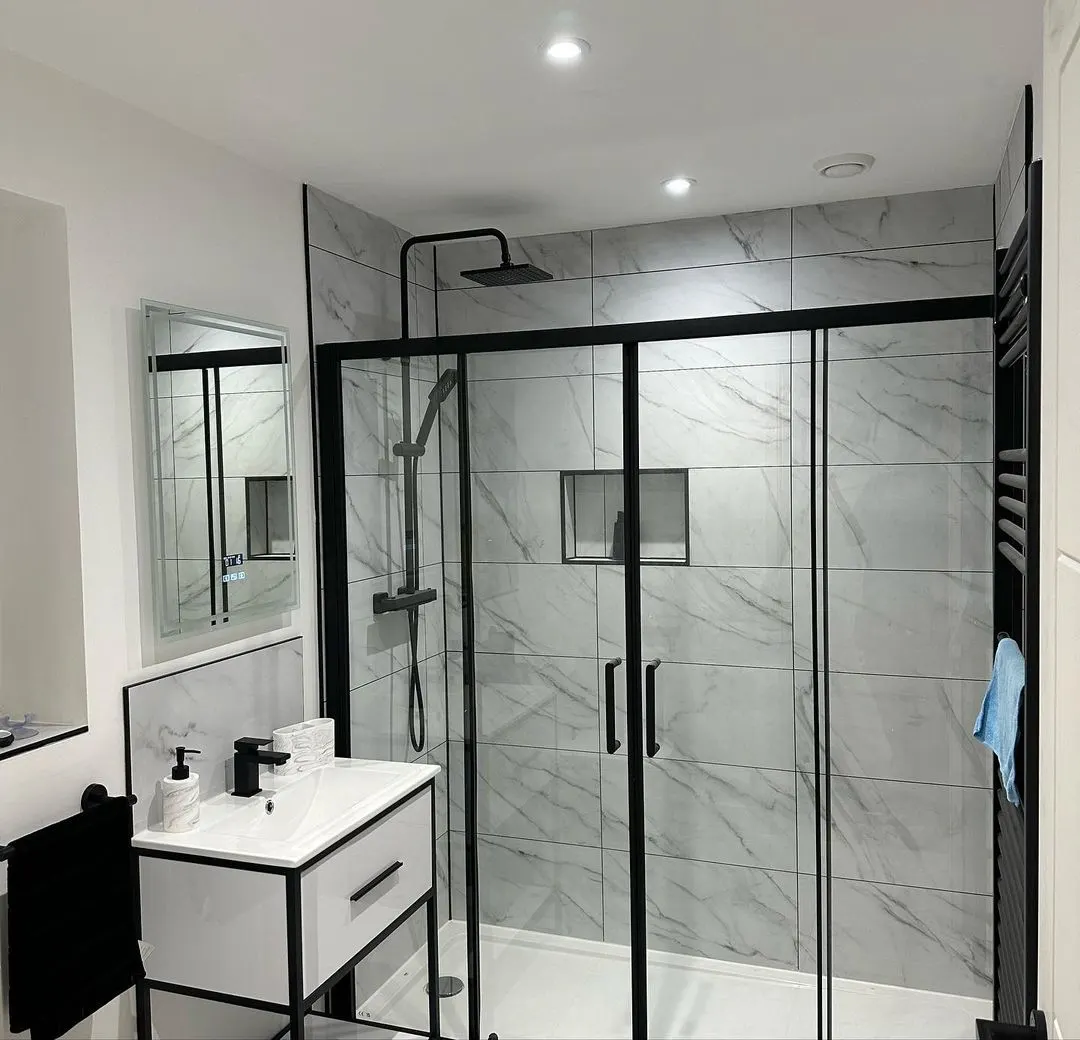
Work in other rooms is a different question. Moving a socket in a bedroom is not notifiable under the three tests, while a new circuit to serve a kitchen island is. If you are unsure whether a proposed point sits inside the bathroom special location, have the position measured before the cable is run. Our guide to extra sockets cost and scope explains how added points are usually described in a quotation, and the outdoor socket guide covers a point outside the house.
How notifiable work is certified
For notifiable work, Approved Document P requires one of three routes, and you should know which one your installer is using before work starts.
- Registered competent person. An installer registered with a competent person scheme self-certifies the work. They give you a BS 7671 electrical installation certificate and, within 30 days of completion, they or their registration body must give you a Building Regulations compliance certificate and tell building control. Registered electricians notify building control for you.
- Registered third-party certifier. An installer who is not registered may appoint a certifier before work begins. The installer notifies the certifier within five days of finishing, and the certifier inspects and tests the work.
- Building control body. An installer who is neither registered nor using a third-party certifier must notify building control before work begins. The local authority or an approved inspector then decides what inspection and testing it needs and issues a completion or final certificate. Expect a building control charge.
GOV.UK’s competent person scheme guidance tells householders to expect the certificate within 8 weeks of completion, while Approved Document P sets a 30 day duty on the installer or scheme. These are different time limits written for different audiences. If nothing has arrived after 30 days, ask the installer first, then their scheme operator, and do not wait for the longer period to expire before asking.
The Electrical Competent Person Register lets you search a postcode or a company name to see whether an electrician is registered with a scheme operator. If a registered electrician cannot resolve a problem, the same page tells you to contact the scheme operator they are certified with. This guide does not say which scheme any particular electrician holds. Check the register for the person you are considering.
Before you agree a price
Ask who certifies the work.
Describe the rooms and circuits involved so the quotation can state what paperwork you will receive.
Ask for a quoteCall 07380 944864
The paperwork to ask for after the job
Different jobs produce different documents. The Electrical Competent Person Register summarises the pattern, and it matches Approved Document P: an Electrical Installation Certificate for any installation work, and a Building Regulations compliance certificate as well where the work was notifiable.
- 1An Electrical Installation Certificate or Minor Works Certificate
Approved Document P says non-notifiable work should be designed, installed, inspected and tested in line with BS 7671 too. Ask for the certificate that matches the size of the job.
- 2A Building Regulations compliance certificate for notifiable work
This is the Part P certificate. A new circuit, a consumer unit replacement or a bathroom circuit alteration should produce one, usually sent by the installer or their scheme within 30 days.
- 3Test results and the circuit schedule
These identify what was tested and what was found, so a future electrician can tell which circuit is which.
- 4Labels and operating information
Approved Document P lists labels on earth connections, bonds, consumer units and RCDs, and operating instructions where relevant, as part of the information to be provided.
- 5A named registration
The certificate should identify the scheme the installer works under, so you can check the register yourself.
Certificates should normally go to the occupier. In a rented home they may go to the person who ordered the work and be copied to the occupier. Landlords should keep them with their inspection records, as set out in our guides to landlord EICR rules and what happens after a failed EICR.
Why an EICR does not replace a Part P certificate
An Electrical Installation Condition Report records the state of an installation as it is. It is not a certificate of compliance for new work. The Electrical Competent Person Register lists an electrical safety check as needing no Building Regulations certificate and no notification, which is exactly why it cannot stand in for one. The ECA’s Part P FAQs add that remedial work arising from a periodic inspection is covered by Part P. So a repair that involves a new circuit or a new consumer unit still needs its own certificate. Our EICR cost guide and guide to C1, C2, C3 and FI codes explain what a report does and does not cover.
What goes wrong without a certificate
The building owner is ultimately responsible for compliance, and Approved Document P notes that local authorities can take enforcement action where work is unsafe and non-compliant, notifiable or not. GOV.UK warns that you may have to correct the work or pay a fine if building regulations are not followed. It also says a certificate from a registered installer appears in solicitors’ searches if you sell, which is why missing paperwork tends to surface during a sale. The Which? Trusted Traders guide makes the same point and notes that uncertified work can complicate a house sale. Our guide to electrical certificates when selling a house lists what buyers’ solicitors usually ask for.
If you suspect past notifiable work was never certified, do not assume an EICR solves it. Ask building control how to regularise it, and ask a registered electrician what inspection and testing they would need to do before anyone can sign anything off. We cannot say what any particular council will accept. Rewire paperwork is covered separately in electrical certificates after a rewire.
Planning around Part P
A few habits keep the paperwork simple. Ask at quotation stage whether the work is notifiable and how it will be certified. Check the register before you agree a price. Treat a consumer unit change as notifiable, and see the consumer unit replacement cost guide and the consumer unit upgrade service for how a quote should describe it. If an EV charger needs its own circuit, whether an EV charger needs a new consumer unit and the EV charger installation cost guide show the surrounding questions. For general advice on picking a tradesperson, read seven checks before choosing an electrician.
When you contact Jack, describe the job, the rooms involved and whether any existing circuit will be altered, and ask for the certification route to be written into the fixed quote. For any specific job, confirm the position with building control, because this guide covers general rules and not your property.
Customer reviews
What customers say about Jack
Jack did a great job installing new spotlights in our kitchen. He turned up on time, worked efficiently, and everything was finished to a really high standard.
Jack and his colleague Freddie arrived on time, worked efficiently, and everything was completed to a really high standard. The price was fair and they left everything clean and tidy afterwards.
I contacted JI Eletrical within 24hrs with an issue and they came to fix it quickly and not had a problem since!
Part P questions
Does replacing a socket need a Part P certificate?
Not in England. Replacements, repairs and maintenance are not notifiable. The work should still meet BS 7671 and be tested, and a socket inside a bathroom special location needs a closer look if it involves altering a circuit.
Do I need a certificate for a new consumer unit?
Yes. Replacing a consumer unit is notifiable under regulation 12(6A). A registered competent person self-certifies it, or the work is certified by a third-party certifier or building control.
Is adding a socket to an existing circuit notifiable?
Generally not, if it is outside a special location. Adding to an existing circuit in a room with a bath or shower, inside the defined space, is notifiable. A new circuit is always notifiable.
How long should I wait for the compliance certificate?
Approved Document P gives the installer or their registration body 30 days from completion. GOV.UK tells householders to expect it within 8 weeks. If it has not arrived after 30 days, ask the installer, then their scheme operator.
Can an EICR replace a missing Part P certificate?
No. An EICR records the condition of an installation and needs no Building Regulations notification. Ask building control how to regularise uncertified notifiable work. This guide cannot say what a council will accept.
Sources checked on 28 October 2026
The legislation and Approved Document P govern; the table above is an explanatory application of them.
- Building Regulations 2010, regulation 12
- Approved Document P: Electrical safety, Dwellings (2013 edition)
- GOV.UK: Approved Document P publication page
- GOV.UK: use a competent person scheme
- Electrical Competent Person Register: choosing an electrician
- IET: Part P for England and Wales
- ECA: Part P FAQs
- Which? Trusted Traders: unregistered electrical work