
A consumer unit replacement is usually a one-day job on paper, but the day is built around testing, not just swapping a box. One training provider estimates about 4 to 6 hours for a simple job in a modern property, 1 to 2 days for a standard one and 2 to 4 days for a complex one. Electrical Safety FirstElectrical Safety First’s best practice guide, the benchmark for this work, says#8217;s best practice guide for this work says the existing installation must be checked before the new board goes in, tested before it is energised, and handed over with an Electrical Installation Certificate.
This guide sets out the sequence those sources describe, so you know what to expect, what to ask and what a good handover looks like. It reflects the Electrical Safety First, Institution of Engineering and Technology (IET), GOV.UK and training-provider pages opened on 4 November 2026, and is written for homes in Cirencester and the Cotswolds, England. It is general information, not a check of your installation, and it does not describe how any one firm runs its day. To talk through your own board, describe it to Jack or see JI Electrical’s consumer unit assessment page.
The day in order
The table below follows the steps in Electrical Safety First’s best practice guide (summarised by Voltimum in 2016, before the 2022 amendment to the wiring regulations) and fills in the homeowner’s side. The exact order on your day is the electrician’s decision, and some steps, such as the pre-work survey, may be done on an earlier visit.
| Stage | What the guidance says | What it means for you |
|---|---|---|
| Before the day | The contractor should encourage an Electrical Installation Condition Report (EICR). Without one, a pre-work survey checks known defects, the existing board, earth loop impedance at the origin, continuity of protective conductors, and insulation resistance | Expect questions about faults, and possibly a short visit before the booked day |
| Supply checks | Main earthing, main protective bonding, meter tails and supply polarity must be verified. If they are inadequate, the customer must be told that upgrading is needed, and work should not proceed if they refuse | A problem found here can add work or stop the job |
| Isolation | Where no suitable isolator exists, the distributor may need to withdraw the cut-out fuse | The whole house goes off. If the meter area has no isolator, the network operator may need to be involved |
| Fitting the board | Work must be designed, erected and verified to the current edition of BS 7671. Domestic boards need a non-combustible enclosure (IET). Connections follow the manufacturer’s torque instructions (IET) | This is the part you see, and often the shortest |
| Testing | At least continuity of protective conductors, ring final circuit continuity, insulation resistance, polarity, earth fault loop impedance, and each RCD tested with an instrument and its test button | The longest part, and the one that justifies the price |
| Energising | Dangerous circuits cannot be reconnected until fixed. Lighting circuits without a protective conductor should not be reconnected unless rewired or given one | A circuit may stay off at the end of the day if testing finds a fault |
| Handover | An Electrical Installation Certificate with inspection and test schedules. Defects left in reconnected circuits are recorded in its comments section | Ask for it, check the edition named, and keep it |
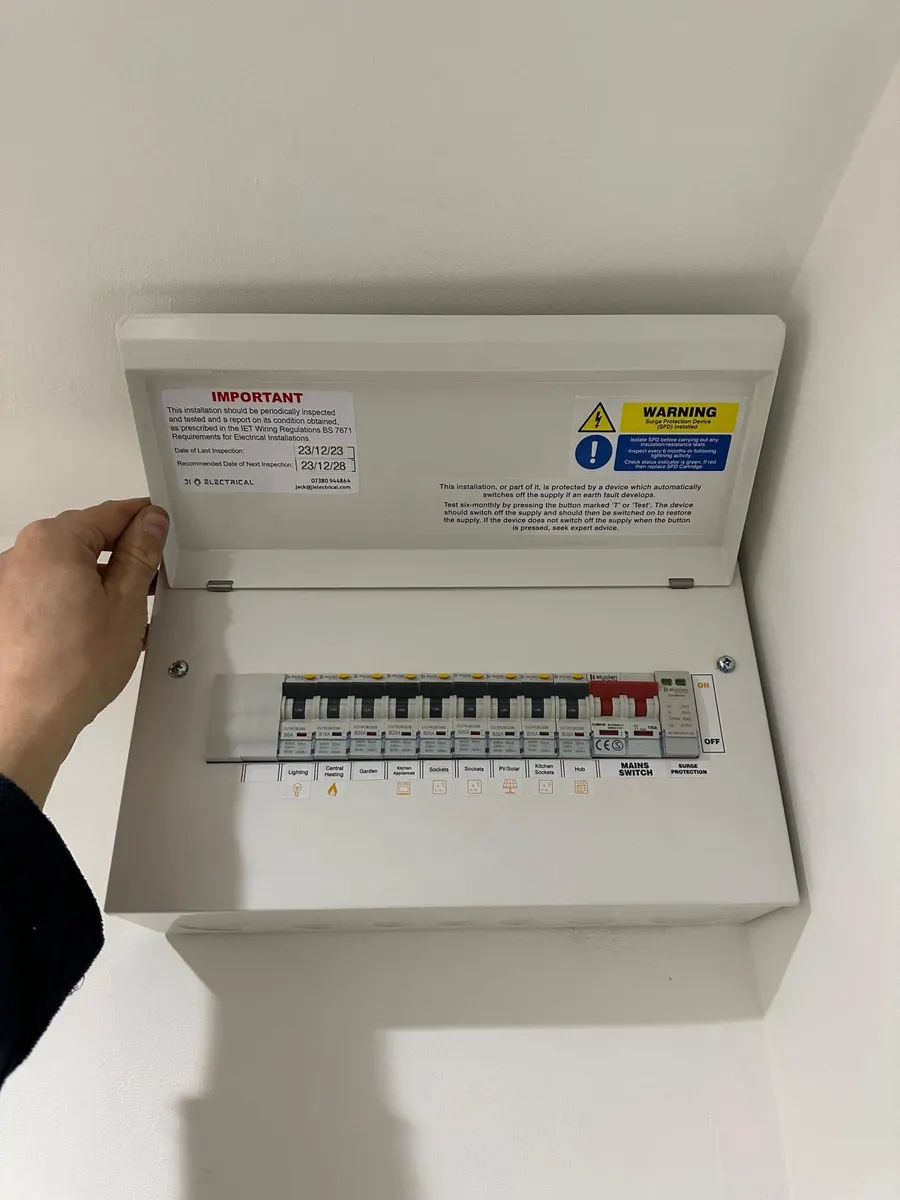
How long it takes and how long the power is off
The training provider elec.training, in a page last reviewed in February 2026, gives three tiers: about 4 to 6 hours including testing for a simple job in a modern property, 1 to 2 days for a standard job in an older property with some bonding or minor circuit work, and potentially 2 to 4 days for a complex job with major earthing work, several faulty circuits or access problems. It adds that the physical swap may take only a few hours, while testing and any remedial work can take much longer. Treat those as one source’s estimates: the page does not explain its basis, and its FAQ asks how long the power will be off without giving a figure.
The practical reading is that most of the time without power sits in the middle of the day, and that a simple swap is not the same as a day with fault-finding in it. Ask for a realistic window in writing, and for an honest answer about what could extend it. If you work from home, keep medication, food or equipment that depend on power in mind, and ask whether any circuits can be restored earlier in the day.
Before the day: what to sort out
Electrical Safety First says a contractor should first encourage the customer to have an EICR prepared. That is not an upsell: the report tells the installer what is already wrong before a new board goes onto it. If you want to know what the report codes mean, see the EICR codes explained, and for a board you are not sure needs replacing at all, read seven reasons to assess a fuse box.
- 1Clear access to the board and meter
Our suggestion, not a source requirement: move stored items and agree where the electrician can work, and ask whether the meter area has an isolator.
- 2Tell them about known faults
The pre-work survey described by Electrical Safety First begins with enquiries about known defects, so mention anything that trips, buzzes or smells.
- 3Agree what happens if testing finds a fault
Dangerous circuits cannot be reconnected until fixed, so ask how a problem would be priced and who decides.
- 4Ask about the certificate and notification
GOV.UK lists replacing fuse boxes among projects that may need building regulations approval, and says you need not apply yourself if the installer is registered with a competent person scheme.
- 5Plan the outage
Our suggestion: tell anyone who shares the property, and think about anything that must stay powered.
Before you book the day
Get the plan for the day in writing.
A clear quote names the testing, the certificate and how a fault found on the day would be handled.
Ask for a quoteCall 07380 944864
What the electrician finds when the old board comes off
Electrical Safety First’s guide says an older board need not be replaced just because it has rewireable fuses, lacks RCD protection or has a plastic enclosure, but the new work must meet the current standard of BS 7671. Where a unit is damaged or overheated, replacement is usually urgent, and the occupant should be told that dangerous circuits cannot be reconnected until fixed and that further work may be needed. If you want the rules on which circuits need RCD protection, see our consumer unit RCD guide.
Two situations in the guide deserve special notice. First, lighting circuits with no protective conductor should not be reconnected unless rewired or given one, and a last-resort route with specific tests and a warning notice exists only where those tests pass. Second, the guide says the consumer unit should not be changed until lead-sheathed or rubber-insulated cables are replaced. Both can turn a one-day swap into a larger job, and both are decisions to make with the electrician on the day, not afterwards.
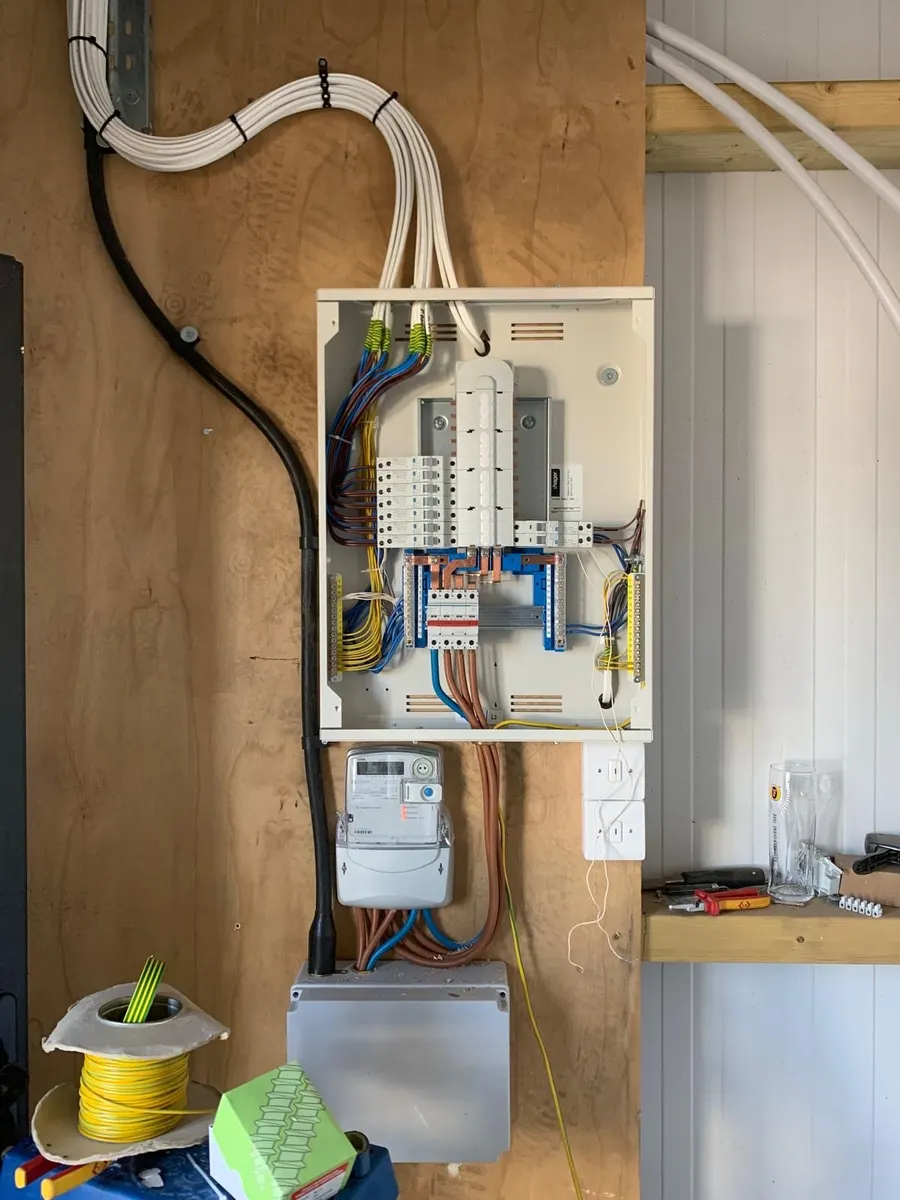
Why testing takes the time
The tests named in the guide are not a formality. Continuity of protective conductors shows the earth path is intact, ring final circuit continuity shows the loop is complete, insulation resistance is measured with the live conductors connected together to avoid damaging electronics, polarity confirms live and neutral are the right way round, and earth fault loop impedance shows a fault would clear quickly enough. Each RCD is tested with an instrument and with its test button. The elec.training page adds the same theme in plainer words: results are recorded on a schedule, and quotes are sometimes “subject to test results”.
That is why a quote that only covers fitting the board deserves a question. Our consumer unit upgrade guide lists what a quotation should include, and the replacement cost guide gives attributed market ranges with the VAT basis. This guide quotes no JI Electrical price.
The handover: what you should leave with
Electrical Safety First’s guide says the installer gives the customer an Electrical Installation Certificate with schedules of inspection and test results, and that existing defects in reconnected circuits are recorded in its comments on the existing installation, with recommendations for improvement. The edition of BS 7671 the work was designed to should be named on it, so ask. Electrical Safety First’s home buyers page says a registered electrician should issue a certificate on completion of notifiable work, and that without it selling may be difficult. Keep the certificate with your property papers; our certificates guide and Part P guide explain the paperwork.
The IET also advises pressing the RCD test button every six months, and says the device should switch the supply off. If a switch starts dropping later, read why electrics keep tripping before resetting it repeatedly. If you plan an EV charger or other large new load, see whether it needs a new consumer unit.
Choosing who does it
The questions above work for any firm. For general checks on picking a local electrician, see seven checks for choosing an electrician in Cirencester, and the services page lists what JI Electrical offers. Whoever you book, ask which scheme will certify the board change and check the membership with that scheme before the work starts. To discuss your own board, ask Jack directly.
Customer reviews
What customers say about Jack
Jack did a great job installing new spotlights in our kitchen. He turned up on time, worked efficiently, and everything was finished to a really high standard.
Jack and his colleague Freddie arrived on time, worked efficiently, and everything was completed to a really high standard. The price was fair and they left everything clean and tidy afterwards.
I contacted JI Eletrical within 24hrs with an issue and they came to fix it quickly and not had a problem since!
Consumer unit replacement day questions
How long does a consumer unit replacement take?
The elec.training page gives about 4 to 6 hours including testing for a simple job in a modern property, 1 to 2 days for a standard job and potentially 2 to 4 days for a complex one. It gives no basis for the tiers, so ask your electrician for a window and what could extend it.
Will the power be off all day?
The sources opened give no fixed duration. elec.training says replacement requires several hours without power. Ask for a window in writing and whether any circuits can be restored earlier.
What happens if testing finds a fault?
Electrical Safety First's guide says dangerous circuits cannot be reconnected until they are fixed, and that the occupant should be told further work may be needed. Defects in circuits that are reconnected are recorded on the certificate.
What certificate should I get?
Electrical Safety First's guide says the installer gives an Electrical Installation Certificate with schedules of inspection and test results. Ask for the BS 7671 edition to be named on it and keep it with your property papers.
Does the work need building regulations approval?
GOV.UK lists replacing fuse boxes and connected electrics among alteration projects that may need approval, and says you do not need to get approval yourself if you use someone registered with a competent person scheme. If unsure, check with a building control body.
Do I need an EICR before a replacement?
Electrical Safety First's guide says the contractor should encourage the customer to have an EICR prepared first. If the customer refuses, a pre-work survey with specified checks is needed instead.
Sources checked on 4 November 2026
Each page below was opened on the day. None gives a JI Electrical price. The BS 7671 text itself and the full Electrical Safety First PDF were not readable, so details come from the sources as summarised.
- Electrical Safety First: replacing a consumer unit, domestic and similar installations (Voltimum, 2016)
- IET: consumer units, consumer guidance
- IET: consumer units and protective devices FAQs
- GOV.UK: building regulations approval, electrical work
- GOV.UK: competent person schemes
- Electrical Safety First: home buyers and sellers
- elec.training: four things to consider when replacing a consumer unit