
A landlord electrical safety certificate price buys an inspection and report, not a promise that the property will pass. Published supplier examples checked on 22 October 2026 include £99 including VAT for a defined London property and £180 including VAT for a standard rental up to three bedrooms in Leicester. These are market examples, not JI Electrical prices or a Cirencester average. Your useful budget separates the inspection fee from any necessary investigation, repairs and return attendance.
For a rental in Cirencester, ask Jack for a fixed quotation through the JI Electrical EICR service. If you want broader property-size comparisons, start with the general Cirencester EICR cost guide. This worksheet concentrates on what the landlord should authorise, receive and keep.
Published prices: compare the limits as well as the total
Two suppliers make their own VAT position explicit. Landlord Certificates Ltd advertises £99 including VAT for one-to-three-bedroom properties with one fuse board and one to ten circuits in its London and M25 area. Its £70 including VAT headline applies to a studio. Neither figure establishes the price for a Cotswolds property.
Leicester-Spark publishes £150 plus VAT, £180 total, for a standard rental up to three bedrooms. It quotes larger properties and HMOs separately. Both pages were checked on 22 October 2026; neither gives a publication date for its own tariff. Treat these as current advertised examples when checked, not a statistical survey or interchangeable offers.
The resulting £99 to £180 span is a range between those particular supplier examples, with VAT included. It is not a typical fee for every rental. Geography, appointment terms, circuit limits and installation scope differ. A larger installation can require a different quotation even where its bedroom count looks modest.
Your landlord electrical safety budget worksheet
| Budget line | Confirm before booking | What closes the line |
|---|---|---|
| Inspection and reporting | Property, boards, circuits, access and complete report included | EICR and accompanying schedules delivered |
| VAT and attendance terms | Final payable total, travel, parking and failed-access terms | Invoice consistent with the agreed basis |
| Investigation or repairs | Separate scope and authorisation if findings require work | Relevant completion evidence and verification |
| Return visit | Whether restricted access or later work creates another charge | Outstanding agreed work and records completed |
| Other safety checks | Appliances, alarms and specialist equipment identified separately | Separate records where applicable |
Use the table as a set of questions, not a list of automatic extras. Some quotations combine elements; others separate them. The point is to remove ambiguity before the visit. Ask what happens if the agreed scope changes, who can approve additional work and how the revised price will be recorded.
A sensible authorisation can distinguish urgent safety action from wider improvements. Give the electrician a reliable contact and ask how any necessary immediate action will be communicated. Do not instruct anyone to leave an identified danger energised while you compare prices. The failed EICR action guide explains the follow-up decisions.
VAT arithmetic without inventing a repair allowance
GOV.UK gives the standard VAT rate as 20 per cent for most goods and services. Using the Leicester supplier’s published example, £150 × 20% = £30 VAT; £150 + £30 = £180 payable. This calculation explains that supplier’s tariff. It does not establish Jack’s VAT status or price.
An inclusive £180 offer and a £150 plus VAT offer have the same total where that rate applies. An inclusive £99 offer stays £99; adding another 20 per cent would be double counting. If a quotation is silent, ask whether VAT is included, additional or not chargeable by that supplier. Compare final totals for identical work.
Do not manufacture a whole-property compliance budget by adding an arbitrary repair percentage to the inspection fee. Until the condition and scope of any work are known, that allowance has no property-specific basis. Instead, keep an inspection line with a confirmed total and an unpriced follow-up line pending the findings. This preserves visibility without implying that repairs are inevitable.
The installation boundary matters more than the certificate label
The document usually meant by “landlord electrical safety certificate” is an Electrical Installation Condition Report. Electrical Safety First explains periodic inspection and testing as an assessment of the installation’s condition, including wiring, protective arrangements and signs of deterioration. A visual-only visit is not the same undertaking.
The IET’s Amendment 4 model EICR records the extent, agreed limitations, observations and inspection and testing schedules. Its validity depends on the accompanying schedules being attached. Ask for the complete electronic document, not just the page containing the overall outcome.
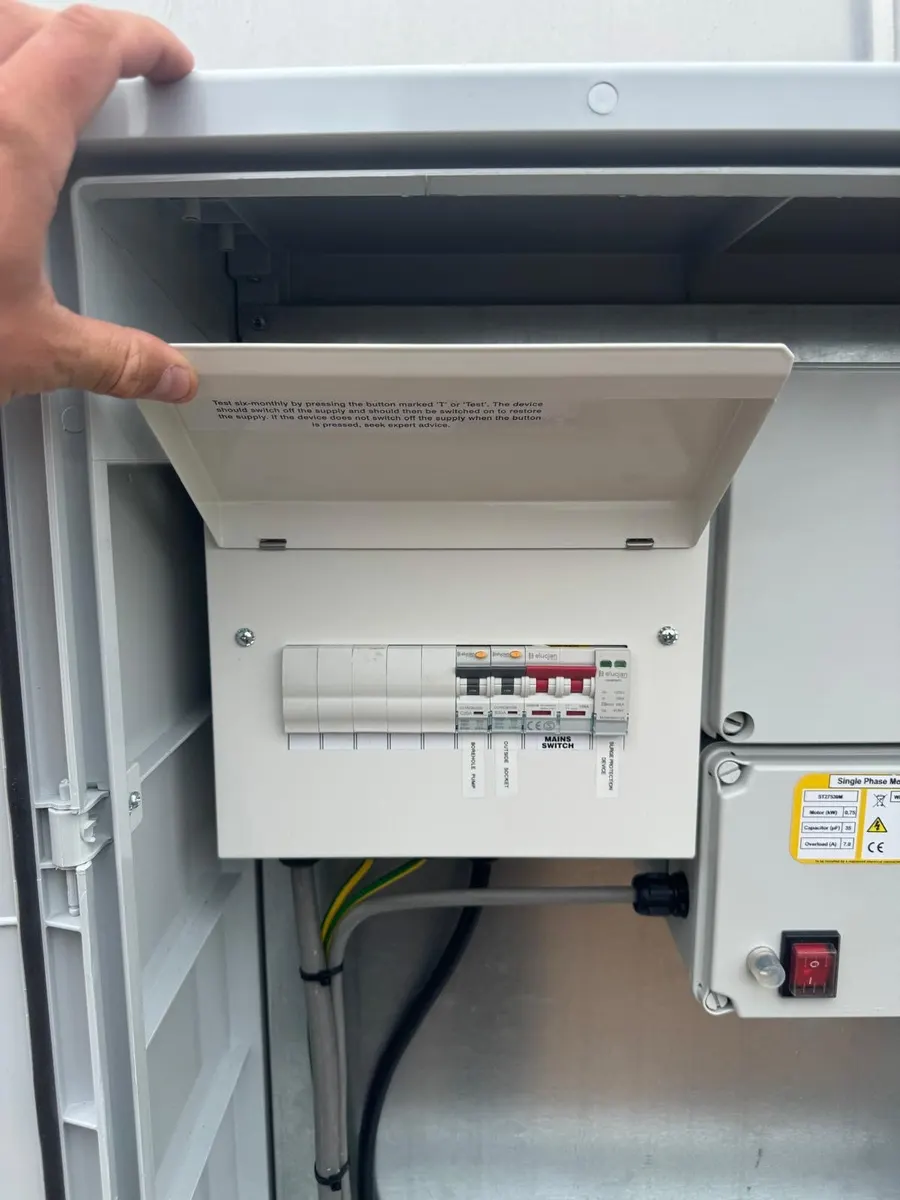
Describe detached garages, outside sockets, additional boards and specialist supplies before requesting a price. The first photograph shows a specialist pump circuit from Jack’s catalogue, not a standard rental package. It illustrates why “one property” can contain several electrical boundaries. Agree what is included and what needs a separate assessment rather than assuming every connected system fits a headline bedroom tariff.
Do not open covers to count circuits for a quotation. Send existing records and ordinary photographs taken with electrical covers in place if requested. Tell the inspector what you do not know. A guessed circuit count creates less useful information than an honest description of the boards and areas that need assessment.
Portable appliances require their own consideration. An EICR on fixed wiring should not be mistaken for proof that every supplied kettle, washing machine or other appliance has been checked. The PAT testing scope and cost guide explains the separate quotation questions. Equally, a general inspection booking does not confirm any particular alarm service from JI Electrical.
Before confirming a visit
Set the inspection boundary.
Discuss boards, outside supplies and report deadlines so the written price covers the agreed work.
Ask for a quoteCall 07380 944864
Check whether another inspection is actually due
Before paying for a repeat, find the existing report and its recommended next-inspection date. Current government guidance for rented homes in England requires inspection at least every five years, with an earlier date where specified. It also says a new tenancy does not automatically require another inspection where the existing report remains valid. A renewal date is not permission to ignore defects or changes.
For the report handover, the guidance requires an existing tenant’s copy within 28 days and a new tenant’s copy before occupation. Necessary remedial or investigative work must be completed within 28 days or the shorter period specified, with the required written evidence supplied afterwards. These are compliance duties, not reasons to assume a fresh full inspection is always chargeable.
Keep the pricing discussion separate from the safety conclusion. The landlord EICR rules guide covers the wider duties, while the EICR classification guide helps interpret observations using the report’s edition. Ask the electrician to explain each proposed work item and the evidence supporting it.
Agree access before the appointment becomes a repeat visit
Tell the tenant and agent what access needs to be arranged, using the electrician’s requirements. Confirm keys, occupied rooms, consumer-unit location and any stored belongings blocking normal access. Explain essential equipment and any needs affected by an interruption to electricity. Do not promise a power-off duration without the inspector’s assessment.
Ask the quotation to distinguish an agreed limitation from an access problem discovered on arrival. A limitation belongs in the report; it should not silently become an assumption that an inaccessible area is satisfactory. Where another attendance is needed, ask what it covers and how it will be priced before booking it.
For several properties, use a separate address, report reference and due date for each. The letting agent handover checklist helps keep those records separate. A portfolio enquiry does not itself establish a discount, combined inspection or guaranteed appointment schedule.
Check the deliverables before filing the invoice
Match the report address to the correct rental and check that all referenced schedules are present. Read the extent and limitations alongside the conclusion. If there are observations, ask which require action, what evidence will record completion and who will provide it. Keep the report, related work records and correspondence together.
Where work follows, an invoice alone may describe payment without establishing the technical completion evidence. Ask what certification or confirmation applies to the actual work. The electrical paperwork guide explains why installation records and condition reports serve different purposes. A replacement board is a separate scope, covered in the consumer unit upgrade guide.
Before appointing anyone, ask about competence for inspection and testing, the written scope and the complete report. Registered Competent Person Electrical provides a registration lookup; confirm the relevant services and competence directly as well. Read the electrician comparison checklist for practical questions beyond a headline fee.
Send one clear request for a fixed quote
Include the rental postcode, property type, approximate size, occupancy, previous EICR and due date. Mention additional boards, outside supplies, known defects, restricted access and the date you need the complete report. Identify who arranges tenant access and who can authorise any additional work.
Finish by asking for the full payable amount, VAT treatment, agreed inspection extent, report delivery terms and return-visit exclusions. Use the contact page or call Jack to discuss your Cirencester landlord EICR quotation. A fixed quote for that property is more useful than applying another supplier’s advertised price to an unknown installation.
Buying a rental? The buyer inspection guide separates survey scope from electrical testing. For a separate fault visit, compare the call-out charge terms.
Before paying for a repeat inspection, use the landlord EICR renewal guide to check the actual due date and any shorter interval.
Customer reviews
What customers say about Jack
Jack did a great job installing new spotlights in our kitchen. He turned up on time, worked efficiently, and everything was finished to a really high standard.
Jack and his colleague Freddie arrived on time, worked efficiently, and everything was completed to a really high standard. The price was fair and they left everything clean and tidy afterwards.
I contacted JI Eletrical within 24hrs with an issue and they came to fix it quickly and not had a problem since!
Landlord certificate cost questions
Is a landlord electrical safety certificate the same as an EICR?
The phrase usually means an Electrical Installation Condition Report on the fixed installation. Confirm that the quotation includes inspection, testing and the complete report with its schedules, rather than a visual check alone.
How much does a landlord electrical safety certificate cost?
Published supplier examples checked on 22 October 2026 include £99 including VAT for a one-to-three-bedroom property within stated London circuit and board limits, and £180 including VAT for a standard rental property up to three bedrooms in Leicester. These are market examples, not Cirencester averages or JI Electrical prices. Ask Jack for a fixed quote.
Are repairs included in the EICR fee?
Do not assume so. Agree whether investigation, remedial work, verification and any return visit are included or separately quoted. An inspection fee does not promise a satisfactory result.
Does a new tenant always mean paying for another EICR?
No. Current government guidance says a new inspection is not automatically required for each new tenancy if the existing report is still valid. Check the report, its next-inspection date, any necessary work and changes to the installation.
Should I add VAT to an advertised certificate price?
Only if the supplier says VAT is additional. The standard rate is 20 per cent where applicable. Ask for the final payable total and never add VAT again to an inclusive price.