
A commercial EICR is priced by the installation, not the floor area, and published UK guides put a small office or shop of up to ten circuits at roughly £250 to £450, with medium premises at £400 to £900 and large or industrial sites climbing to £2,000 or more. None of the guides we opened is specific to Cirencester, most do not say whether VAT is included, and none of them is a JI Electrical price. Treat them as a way to sense-check a quote, then ask Jack for a fixed figure for your actual premises.
This guide is for Cirencester and Cotswolds businesses that need an Electrical Installation Condition Report on an office, shop, workshop, unit or similar non-domestic premises. It uses four UK price guides published or labelled for 2026, the Health and Safety Executive, the Electricity at Work Regulations 1989, an IET article on inspection intervals and the IET model EICR form. Where the sources disagree we say so rather than average them.
Commercial EICR price ranges published in 2026
Four public guides give commercial figures. They use different premises bands and different assumptions, so the table keeps them apart and records what each one says about VAT.
| Published source | Figure it gives | VAT position | How to read it |
|---|---|---|---|
| Fergus, commercial EICR guide (4 May 2026) | Small office or retail unit, up to 10 circuits: £250 to £450. Medium, 10 to 30 circuits: £400 to £800. Large or multi-floor, 30 or more circuits: £800 to £2,000 or more. Industrial unit or factory: £500 to £2,500 or more. Warehouse with basic systems: £300 to £600 | Not stated. The guide tells readers to ask whether a quote includes VAT | The most detailed banding, and the only one that separates a warehouse from a factory. Its own FAQ and table give slightly different top figures |
| Trade2Base, EICR costs UK (8 June 2026) | Small to medium commercial unit, 10 to 30 circuits: £200 to £600. Or £12 to £18 per circuit plus a £60 to £80 site visit fee | Not stated | Describes its rates as reflecting the Midlands and North, with London and the South East 15 to 25 per cent higher. |
| MyConstructor, commercial EICR cost (undated, labelled 2026) | Small office or retail, up to 10 circuits: from £250 to £400. Medium: £400 to £900. Large commercial or industrial: £900 to £2,000 or more | Not stated | Similar shape to Fergus, with a looser medium band that gives no circuit count |
| Aspect, one provider's published rates (undated) | Commercial, up to 10 circuits: from £360 plus VAT at the weekday rate, plus £27 plus VAT for each extra circuit | Stated as plus VAT | One provider's own price list, not a Cirencester price. At the standard 20 per cent rate that opening figure becomes £432, which is our arithmetic, not Aspect's |
Read the figures as evidence of the market, not as a tariff. The sources are Fergus's commercial EICR guide, Trade2Base's EICR cost guide, MyConstructor's commercial EICR page and Aspect's electrical safety check page. None is a JI Electrical figure, and none was written for Cirencester.
The disagreements matter. A medium premises is £400 to £800 in one guide, £400 to £900 in another and £200 to £600 in a third. That spread is the reason a firm should not budget from a headline number. It is a sign that circuit count, supply type and access are doing most of the work.
What actually moves a commercial EICR price
The four guides agree on the main drivers even where they disagree on the pounds.
Circuits and boards, not square metres
MyConstructor says cost depends mainly on inspection time and system complexity rather than floor area. Aspect's page tells readers to allow up to 30 minutes per circuit. If that holds for your site, ten circuits is about five hours of testing and thirty is about fifteen, which is our arithmetic from its figure and would plainly change the price. Several distribution boards, sub-boards in outbuildings and a separate lighting board all add circuits to the schedule.
Three-phase and larger supplies
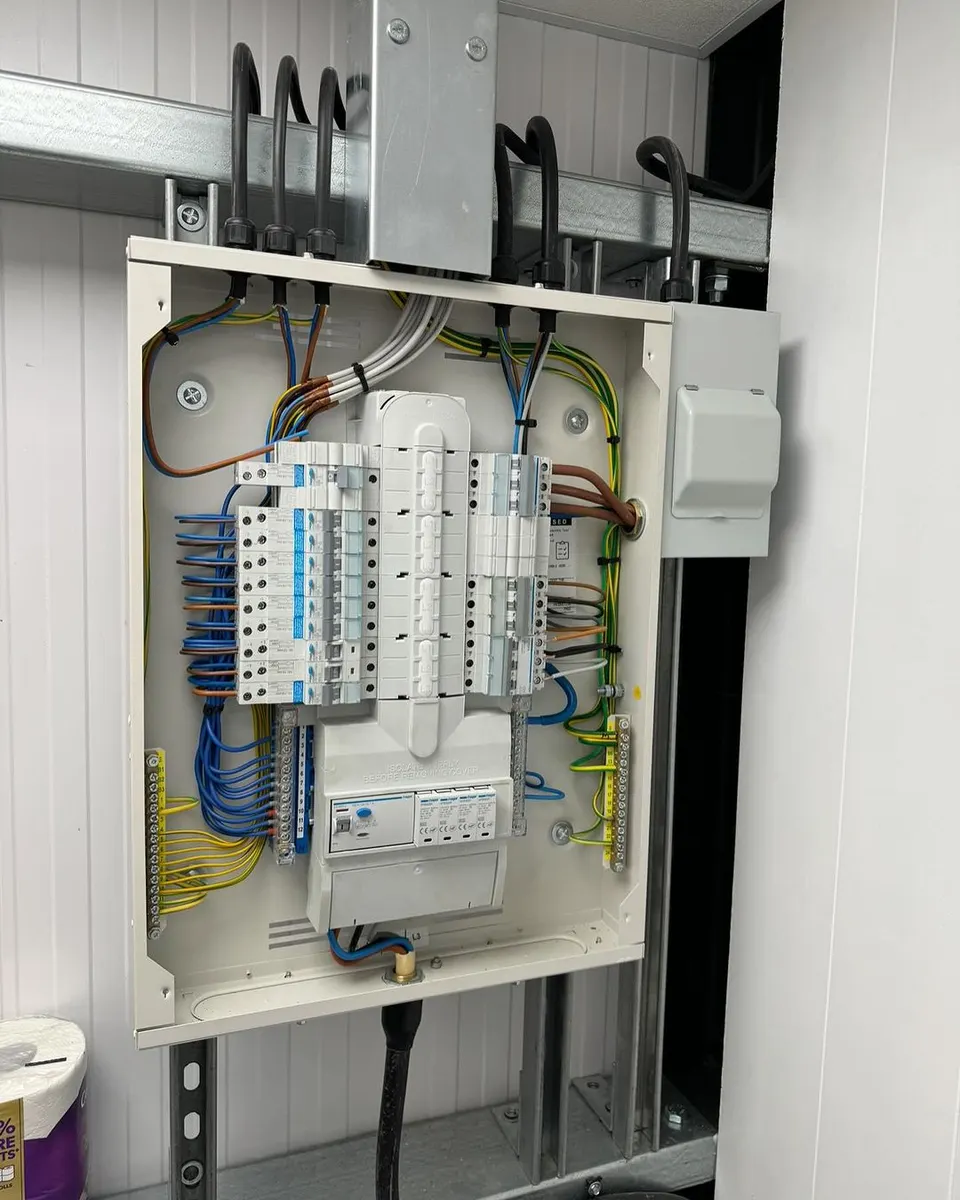
MyConstructor lists three-phase systems as a source of complexity. A three-phase distribution board needs more careful isolation planning than a single-phase consumer unit, and the report schedules grow with it. Domestic market bands do not carry across. The photograph above, from Jack's own project catalogue, shows a three-phase board with the cover off. It is there to show what a commercial board looks like, not as a priced example.
Access and when the power can go off
Testing needs parts of the installation to be isolated. For a business, that means agreeing when. A shop that trades through the week, a unit with refrigeration, or an office with servers will have limits on shutdowns, and those limits belong in writing. The IET model EICR form has a field for operational limitations and the reasons for them. A limitation that is agreed and recorded is honest. A limitation that is hidden to hit a lower price is not.
Time of day and urgency
Aspect quotes a weekday rate and says evenings and weekends cost more, without giving a figure. MyConstructor says emergency inspections may be priced higher. If your premises can only be tested out of hours, ask for that to be priced from the start.
Location
Trade2Base says its rates reflect the Midlands and North and that the South East runs 15 to 25 per cent higher. Cirencester is in neither group, so a national average is a rough guide at best. This is another reason to get a local written quote.
Is a commercial EICR a legal requirement?
There is no single commercial equivalent of the landlord rules for rented homes, and the sources are careful about this. What the law does require is that the electrical system is maintained so that it does not become dangerous.
Regulation 4(2) of the Electricity at Work Regulations 1989 says that, as may be necessary to prevent danger, all systems shall be maintained so as to prevent, so far as is reasonably practicable, such danger. The HSE's electricity FAQ adds that installations should be tested often enough that there is little chance of deterioration leading to danger. It gives no fixed interval, and it advises using someone competent to inspect and test.
The IET's Wiring Matters article on periodic inspection or planned maintenance makes the same point from the engineering side. It says the legislation it discusses requires an installation to be maintained, with no specific requirement for periodic inspection and testing, and that a planned maintenance programme can be an alternative if it provides the same confirmation. It also notes that licensing conditions, mortgage or loan requirements, insurance claims and lease terms can each make a periodic inspection report effectively necessary. That article is from winter 2008, so use it for the principle rather than for current intervals.
The practical reading is that a periodic EICR is the usual way to show the installation is being kept safe, not that a statute names the document. If you need to show an insurer, a landlord, a licensing authority or a lender that the installation has been checked, an EICR is what they normally ask for. Check your own insurance schedule and lease, because those terms differ.
How often does a business need one?
The sources give typical intervals but no legal one, and the inspector sets the actual date.
| Premises | Fergus (2026) | IET Wiring Matters table (2008, from Guidance Note 3) |
|---|---|---|
| Offices and retail units | Every 5 years | Not listed |
| Restaurants and hotels | Every 3 to 5 years (public-facing premises) | 5 years |
| Public houses | Not listed separately | 5 years |
| Industrial sites and factories | Every 3 years | Not listed |
| Leisure complexes, theatres, places of public entertainment | Not listed separately | 3 years |
| Cinemas | Not listed separately | 1 to 3 years |
| Swimming pools, launderettes, petrol filling stations, caravan parks | Wet environments, 1 to 3 years | 1 year |
The IET column is labelled as typical maximum permitted intervals under local authority licensing conditions, so it applies to licensed premises, and the article is nearly twenty years old. Fergus says the inspector sets the next date and that some insurers require three-yearly inspections. Trade2Base gives a similar pattern and attributes its intervals to BS 7671, but we could not check that attribution against the standard, so we do not repeat it as fact. The one place a date is formally recorded is Section F of the IET model EICR form, where the inspector recommends the installation is further inspected and tested before a stated date, subject to any remedial action.
Ask the inspector to explain the date on your report and what they based it on: how the premises are used, the age and condition of the installation, and how well it has been maintained. Fergus gives shorter intervals for wet environments and public buildings than for offices, so the type of premises is the first thing the inspector will weigh.
Before you compare quotes
Put the scope in writing.
Circuits, limitations, shutdown times, VAT and the complete report decide what a price covers. Ask Jack to quote against the same list.
Ask for a quoteCall 07380 944864
What a commercial EICR quote should say
The most useful comparison is a written scope. Put the same information in front of every electrician and check each quote against the same list of things to settle.
- 1Premises and extent
The address, how the premises are used and which buildings, units and boards are inside the inspection. A yard store or an outbuilding on a separate supply may be a different job.
- 2Circuit count and any cap
The number of circuits the price covers, and what each extra circuit costs. Aspect's published rate shows how a per-circuit charge appears in a real price list.
- 3Agreed limitations
What cannot be inspected or isolated, and why. The IET form says concealed cables in trunking, conduit, under floors and in roof spaces are not inspected unless specifically agreed, so ask whether any of that is meant to be included.
- 4Shutdown plan
When supplies will be switched off, for how long, and which equipment needs protecting or moving. Name a contact who can say yes or no on the day.
- 5The complete report
The EICR with its schedules of inspections, circuit details and test results. The IET form is only complete with those schedules attached.
- 6VAT
Whether the figure includes VAT, adds it or is outside the scope of it. Most of the guides above are silent, which is a good reason to ask.
- 7Out-of-hours and travel
Whether evening or weekend attendance, travel and parking are in the price.
- 8Remedial work
Fergus and MyConstructor both say repairs are priced separately. Ask how findings will be explained and how quickly a remedial quote follows.
- 9What is not included
Portable appliances, fire alarm servicing and emergency lighting tests are different checks. Say if you want any of them in the same visit.
The same questions apply when comparing any electrician, so the seven checks for choosing an electrician in Cirencester is worth reading alongside this list.
Reading VAT on a business quote
GOV.UK states the standard VAT rate is 20 per cent and that the rate a business charges depends on its goods and services. Whether you can reclaim that VAT depends on your own VAT registration and the nature of your business, which is a question for your accountant, not for an electrician or this guide.
For comparing quotes, the safe approach is to compare like with like. A figure quoted plus VAT is not directly comparable with a figure that already includes it. Aspect's published rate is the only one of the four guides that says plus VAT, and the arithmetic above shows how far apart the two bases can be. Ask every electrician for a total and a statement of how VAT is treated.
What the report tells you, and what it does not
An EICR records the condition of the fixed installation on the inspection date, within the agreed extent and limitations. On the IET form, an unsatisfactory assessment means a dangerous (code C1) or potentially dangerous (code C2) condition has been found, and observations coded C1 and C2 should be acted on as a matter of urgency. Codes C3 (improvement recommended) and FI (further investigation advised) are advisory and do not by themselves make the overall assessment unsatisfactory. Our guide to the C1, C2, C3 and FI codes explains how to read them, and what happens after a failed EICR covers the route from findings to a defined repair scope.
It is not a guarantee that nothing will fail next week, and it is not a fire risk assessment. If you are the person in control of non-domestic premises, GOV.UK says you are the responsible person who must carry out and regularly review a fire risk assessment. That is a separate duty from an electrical inspection, and the GOV.UK page does not make the EICR a substitute for it.
Where PAT testing fits
A commercial EICR covers the fixed installation, not the kettles, monitors and power tools plugged into it. Portable appliance testing is a separate exercise. The HSE says PAT is not a legal requirement in itself: the law requires an employer to ensure electrical equipment is maintained to prevent danger, and how often depends on the equipment and the environment. For frequencies it points to its guide to maintaining portable equipment, HSG107.
If you want both done, ask for them to be quoted together but itemised, so you can see each cost. Our PAT testing cost guide covers the market ranges for that side.
What JI Electrical lists, and what to ask Jack
The commercial and industrial page says JI Electrical provides commercial electrical work for businesses in Cirencester and the Cotswolds, and its list of work that may need planning includes inspection, testing and follow-up work identified by a report. It also says the exact service, site requirements and availability need to be confirmed before a quotation is agreed, and that its list does not promise every specialist system, out-of-hours attendance or a long-term contract. This guide does not go beyond that.
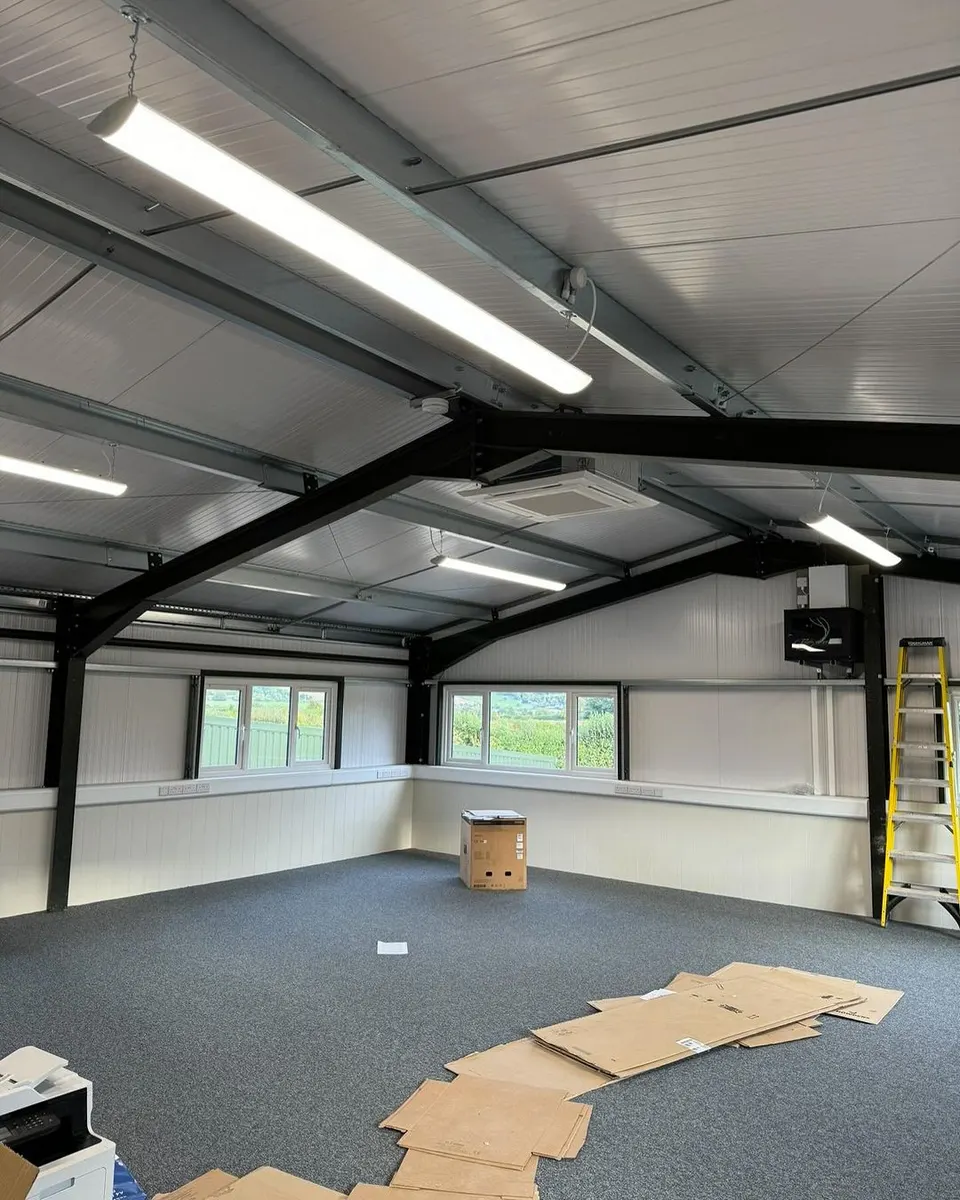
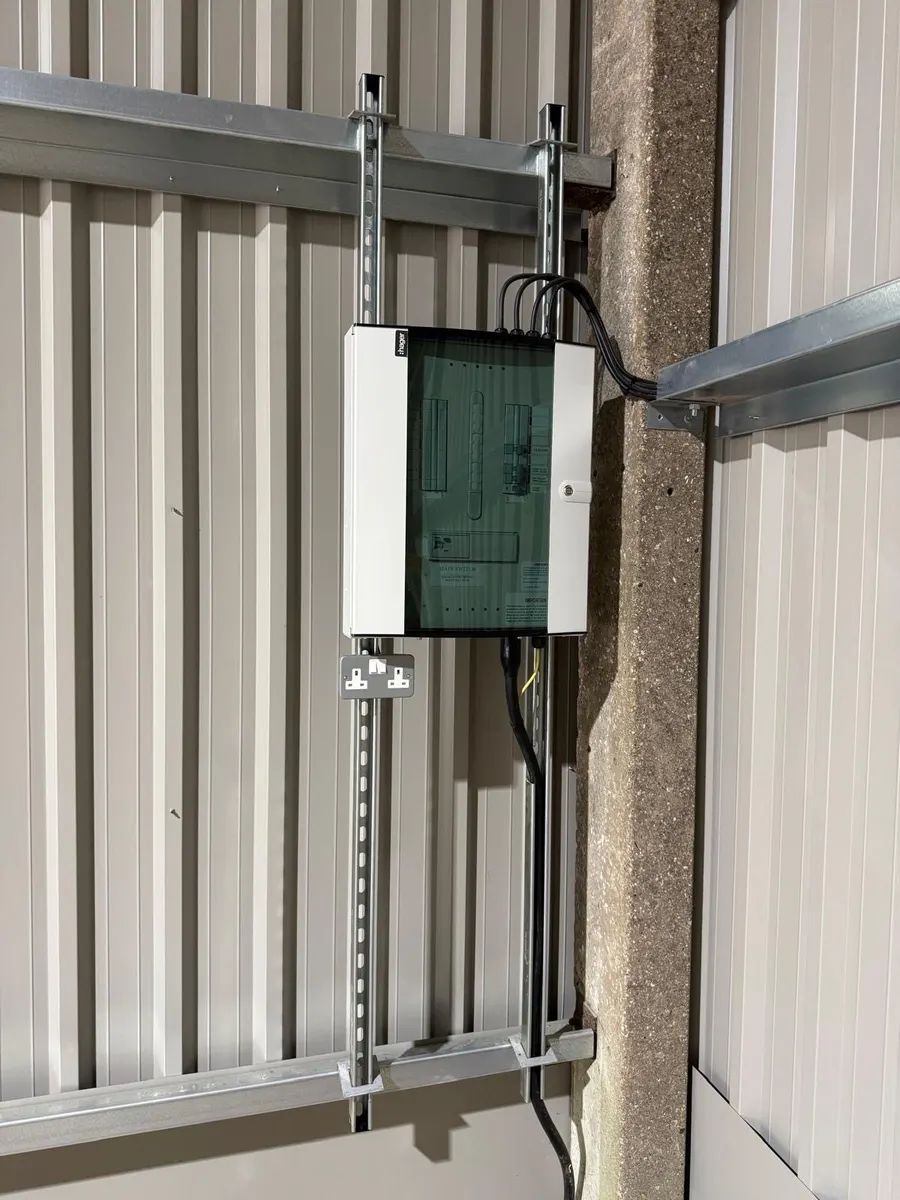
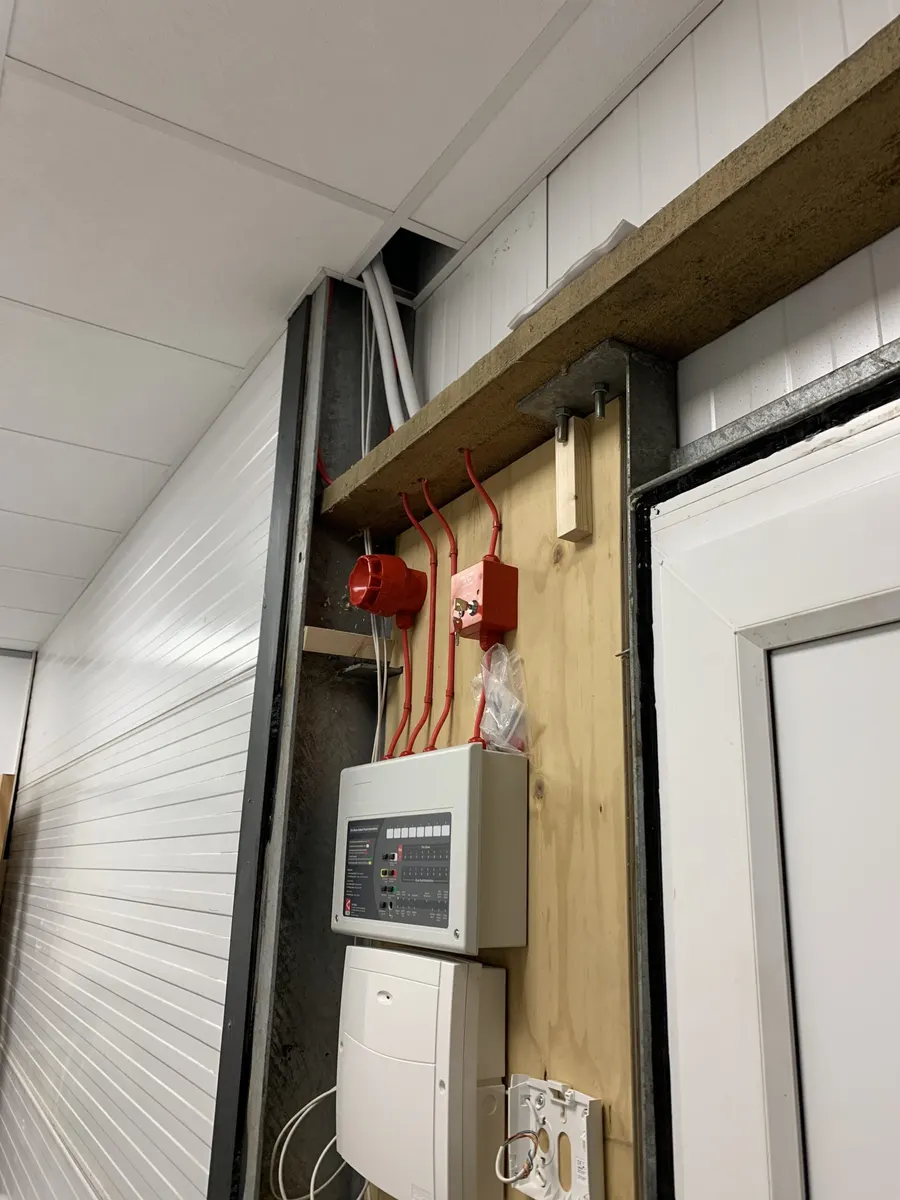
So the honest next step is a question, not an assumption. Ask Jack whether he will inspect and report on your type of premises, what supply you have, and whether any shutdown or out-of-hours constraint changes how he would approach it. The photographs in this article are from his commercial projects and show boards and finished spaces, not an inspection in progress.
Information to send for a fixed quote
- the site address and what the premises are used for;
- whether the supply is single-phase or three-phase, if you know;
- the number of distribution boards and approximate circuits;
- any outbuildings, yards, external lighting or separately supplied units;
- trading hours, and when the power can be switched off;
- any named contact and access or permit requirements;
- the previous EICR, certificates or drawings, if you have them; and
- the date the report is needed by, and why (insurer, lease, licence or lender).
If you are weighing a domestic property instead, the domestic EICR cost guide and the landlord EICR guide cover the rules that do apply to rented homes, including the five-year cycle, which does not apply to your business premises in the same way. For the wider service, see the EICR page for Cirencester and the Cotswolds, and a related look at call-out charges in Cirencester.
Customer reviews
What customers say about Jack
Jack did a great job installing new spotlights in our kitchen. He turned up on time, worked efficiently, and everything was finished to a really high standard.
Jack and his colleague Freddie arrived on time, worked efficiently, and everything was completed to a really high standard. The price was fair and they left everything clean and tidy afterwards.
I contacted JI Eletrical within 24hrs with an issue and they came to fix it quickly and not had a problem since!
Commercial EICR questions
How much does a commercial EICR cost?
Published 2026 guides put a small office or retail unit of up to ten circuits at about £250 to £450, medium premises at £400 to £900 and large or industrial sites at £800 to £2,500 or more. Most do not state VAT and none is a JI Electrical price. Ask Jack for a fixed quote.
Is a commercial EICR a legal requirement?
Regulation 4(2) of the Electricity at Work Regulations 1989 requires systems to be maintained to prevent danger. The HSE says installations should be tested often enough that deterioration is unlikely to lead to danger, and gives no fixed interval. An EICR is the usual way to show it, and insurers or leases may ask for one.
How often does a business need an EICR?
There is no single legal interval. Fergus suggests about every five years for offices and shops, every three for industrial sites and shorter for wet or public buildings. The inspector records a recommended date on the report, so ask how it was chosen.
Does the quote include VAT?
Check each quote. Of the four guides we opened only Aspect's published rate states plus VAT; the others are silent. GOV.UK gives the standard rate as 20 per cent. Ask for a total and how VAT is treated.
Is PAT testing part of an EICR?
No. An EICR covers the fixed installation. PAT covers portable appliances and is a separate check, which the HSE says is not a legal requirement in itself. Ask for the two to be itemised if quoted together.
Does JI Electrical carry out commercial EICRs?
Jack's commercial page lists inspection, testing and follow-up work identified by a report for businesses in Cirencester and the Cotswolds, with the scope to be confirmed before a quotation. Ask him whether he will inspect your type of premises.
Sources checked on 12 November 2026
Sources not opened: MyBuilder's EICR cost guide (access refused) and Checkatrade's EICR pages. Neither is cited. The IET model EICR form and the IET Wiring Matters article were read as downloaded PDFs. This is general guidance, not advice on a specific installation, and no figure here is a JI Electrical price.
- legislation.gov.uk: Electricity at Work Regulations 1989, regulation 4
- HSE: electricity at work FAQ
- HSE: portable appliance testing FAQ
- IET Wiring Matters: periodic inspection or planned maintenance (Winter 2008)
- IET: model EICR forms for BS 7671:2018+A4:2026
- GOV.UK: VAT rates
- GOV.UK: workplace fire safety, your responsibilities
- Fergus: commercial EICR guide (4 May 2026)
- Trade2Base: EICR costs UK (8 June 2026)
- MyConstructor: commercial EICR cost
- Aspect: electrical safety check page